
Why Independent Project Assessments Matter to Investors and Lenders
As capital projects become larger, more complex, and increasingly capital-intensive, investors, lenders, private equity firms, and financial institutions are placing heightened focus on execution risk when evaluating investment opportunities.
While technical feasibility, market fundamentals, and project economics remain important, experience has shown that many projects fail to achieve expected returns due to cost overruns, schedule delays, inadequate forecasting, and ineffective project execution.
For capital providers, the fundamental questions remain consistent across industries:
The answers to these questions depend largely on the effectiveness of the project's front-end planning and overall project execution strategy
This is where an Independent Project Readiness Assessment (IPRA) can provide significant value.
What is an Independent Project Readiness Assessment?
An Independent Project Readiness Assessment is an independent evaluation of the project's ability to effectively define, measure, monitor, forecast, and control project performance throughout execution. Typically executed by seasoned project professionals, each having over 30 years of capital project planning and delivery experience.
The assessment focuses on determining whether the project framework, front-end planning activities, project execution plan, and other required front-end deliverables provide a reliable basis for decision-making and whether management can confidently forecast project outcomes.
For lenders and investors, the IPRA serves as an independent validation of the systems, processes, and methodologies used to develop and manage the project's quality, cost, schedule, risk, operability, and reliability.
Why IPRA is Valuable to Lenders
Investors are ultimately evaluating risk.
A project may have an attractive business case, but if the underlying cost estimate and schedule are based on incomplete scope definition, weak controls, or unrealistic assumptions, the probability of achieving the projected returns may be significantly reduced.
An IPRA helps lenders and investors gain confidence that:
- Project scope has been adequately defined and captured.
- Cost estimates are based on a structured and complete scope.
- Project schedules are realistic and properly integrated.
- Risks have been identified and appropriately considered.
- Operability and Reliability meet defined expectations
- Forecasting methodologies are reliable.
- Project performance can be measured and reported accurately.
- Management will receive early warning of potential deviations from plan.
Ultimately, the IPRA helps investors assess not only whether a project is financially attractive, but also whether it can be successfully delivered.
Key Areas Evaluated in an IPRA
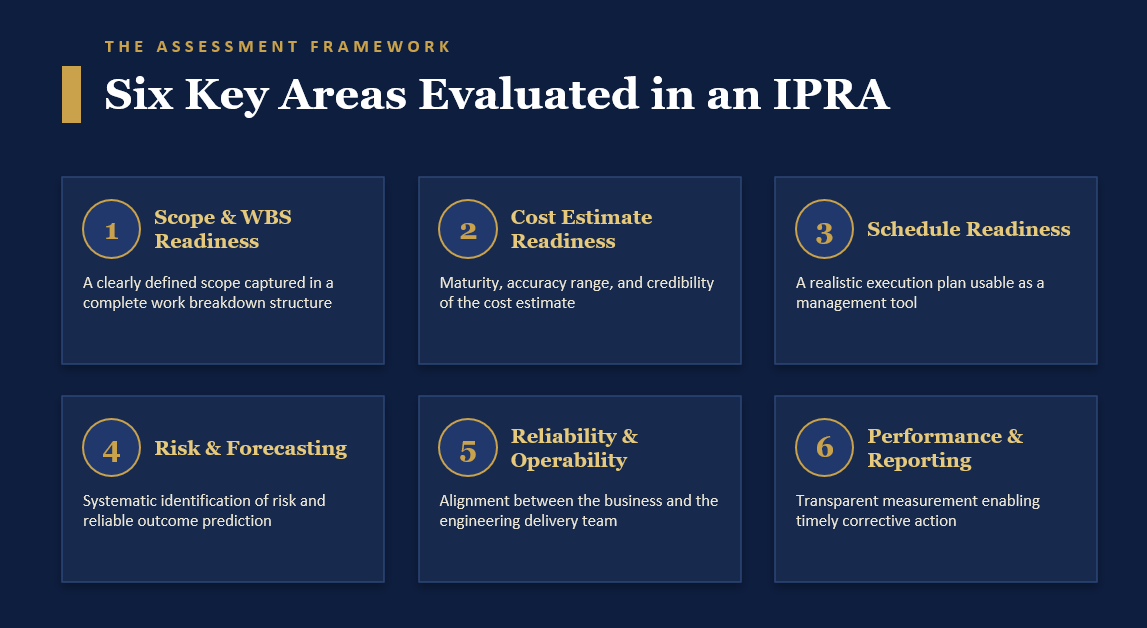
Scope and Work Breakdown Structure (WBS) Readiness
The foundation of every project control system is a clearly defined scope.
The IPRA evaluates whether the project scope has been properly captured, structured, and controlled through a comprehensive Work Breakdown Structure (WBS).
This assessment considers:
- Completeness of scope definition
- Alignment between scope, estimate, and schedule
- WBS structure and coding systems
- Scope change management processes
- Traceability of project deliverables
For lenders, this is particularly important because the WBS forms the basis for the cost estimate, project schedule, progress measurement, forecasting, and reporting systems. If the scope is incomplete or poorly structured, all subsequent project controls become less reliable.
Cost Estimate Readiness
The IPRA evaluates the maturity and reliability of the project's cost estimate, including:
- Estimate classification and accuracy range
- Confidence Level of achieving the defined cost estimate
- Basis of estimate documentation
- Quantity development methodology
- Labor and productivity assumptions
- Escalation assumptions
- Contingency development
- Estimate validation processes
The objective is to determine whether the estimate provides a credible basis for investment decisions.
Schedule Readiness
The assessment evaluates whether the project schedule represents a realistic execution plan and whether it can be used as an effective management tool.
Areas reviewed include:
- Schedule development methodology
- Confidence level of achieving the stated timeline
- Critical path identification
- Resource planning assumptions
- Procurement and long-lead equipment integration
- Construction sequencing
- Milestone definitions
- Schedule contingency and risk allowances
Particular attention is given to the credibility of key milestones associated with revenue generation and return on investment.
Risk and Forecasting Readiness
The IPRA evaluates whether project risks are systematically identified, assessed, and incorporated into project forecasts.
This includes:
- Risk identification processes
- Cost and schedule risk assessments
- Contingency management
- Forecasting methodologies
- Estimate at Completion (EAC) processes
- Trend and change management systems
The objective is to determine whether management can reliably predict future project outcomes.
Reliability and Operability
This assessment assures the investor that alignment has been reached between the owner business unit and the project engineering and delivery team.
IPRA reviews
- Business Engineering Alignment
- Operating Philosophy
- Maintenance and Turn Around Strategy
- Future Expansion provisions
- Operating Life expectations
- Reliability requirements
These business attributes drive the design, flexibility and robustness of the project’s cost/schedule and execution risks
Performance Measurement and Reporting
Reliable reporting is essential for both project management and external stakeholders.
The IPRA reviews:
- Progress measurement methodologies
- Cost and schedule integration
- Performance metrics and KPIs
- Reporting frequency and content
- Forecasting accuracy
- Executive and lender reporting processes
Strong reporting systems provide transparency and enable timely corrective actions when required.
Benefits to Investors and Financing Institutions
An IPRA provides independent assurance that the project's framework can support successful execution and reliable forecasting.
The assessment helps lenders and investors:
- Validate the credibility of project cost estimates.
- Assess confidence in project schedules.
- Understand key execution risks.
- Evaluate the reliability of project forecasts.
- Improve investment decision-making.
- Reduce uncertainty associated with project delivery.
Most importantly, it provides an independent view of whether the information being used to support funding decisions can be relied upon.
Applicable Across Capital-Intensive Industries
The principles of IPRA are equally valuable across a wide range of industries, including:
- Mining and metals
- Power generation and transmission
- Oil, gas, and petrochemicals
- Pharmaceuticals and life sciences
- Data centers
- Manufacturing facilities
- Infrastructure and transportation projects
- Renewable energy developments
Regardless of industry, investors are evaluating the same fundamental drivers: scope, cost, schedule, risk, and the likelihood of achieving projected returns.

Conclusion
The Independent Project Readiness Assessment provides a structured and independent evaluation of the project's ability to successfully manage and control scope, cost, schedule, risk, forecasting, and reporting.
For lenders and investors, the IPRA offers valuable insight into the reliability of the information supporting investment decisions and provides increased confidence that the project can achieve its planned objectives.
While IPRAs are particularly valuable for lenders, investors, and financing institutions evaluating potential investments, the IPRA is equally valuable for owner companies funding projects with their own capital, providing an independent assessment of the project's readiness to achieve its cost, schedule, and business objectives while reducing execution risk and improving the probability of a successful outcome.
In an environment where capital allocation decisions are increasingly influenced by execution risk, a well-executed IPRA can become a powerful tool for improving transparency, reducing uncertainty, and strengthening investor confidence.