
Owner organizations continuously search for the formula that consistently delivers capital projects on time, on budget, and aligned with business objectives. Many Owners have invested heavily in project management software, benchmarking studies, performance metrics, and detailed procedures. Yet despite these efforts, strategic projects still too often miss the mark.
The Real Challenge: Aligning Strategy with Execution
Every Owner organization establishes goals and develops strategic plans intended to create value. The challenge is translating those plans into results. While many companies focus on project metrics as a way to improve performance, metrics alone do not create successful outcomes. Owner organizations frequently achieve favorable benchmark scores yet continue to experience disappointing business results.
The reason is simple: capital project performance depends on the alignment of three critical elements—the organization, the project delivery process, and the project team. When these elements pull in different directions, even sophisticated management systems can fail to produce desired results.
Understanding Organizational Maturity
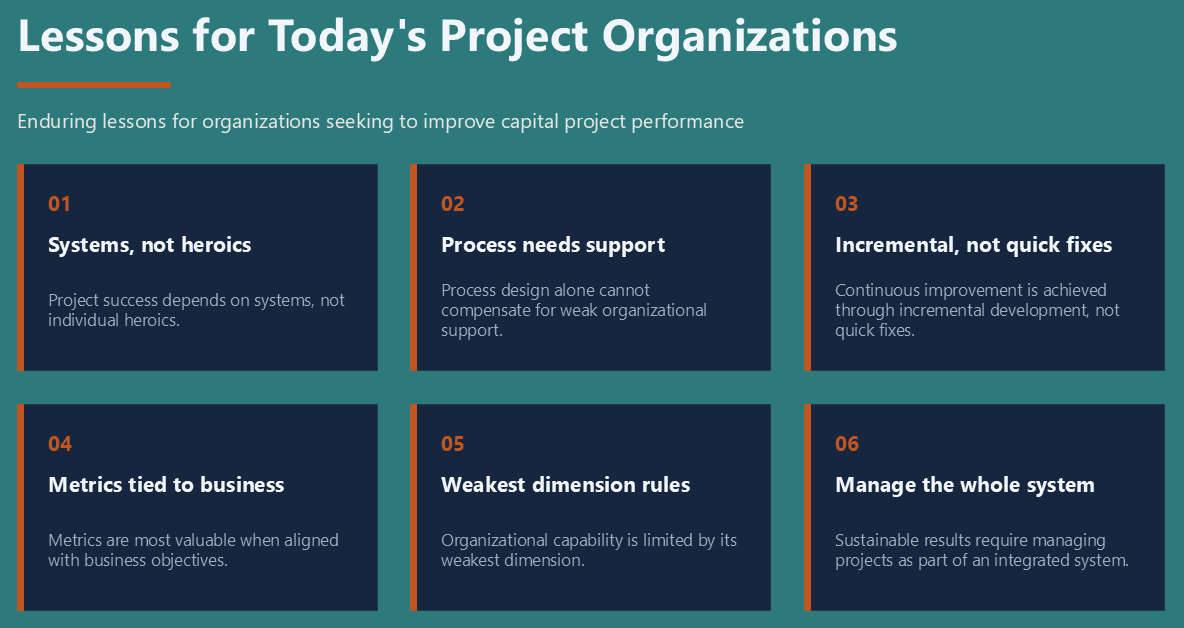
A key insight is that project success is not solely determined by individual talent. In less mature organizations, successful projects often depend on the extraordinary efforts of a few experienced individuals. While this can occasionally produce outstanding results, it is difficult to sustain and almost impossible to replicate consistently.
In contrast, mature organizations rely on disciplined, repeatable processes that are understood and supported throughout the enterprise. Roles and responsibilities are clearly defined, expectations are realistic, and project outcomes become more predictable because success is embedded in the system rather than dependent on individual heroics.
The Five Levels of Project Management Maturity
Pathfinder identifies five stages of organizational maturity that represent a continuous improvement journey.
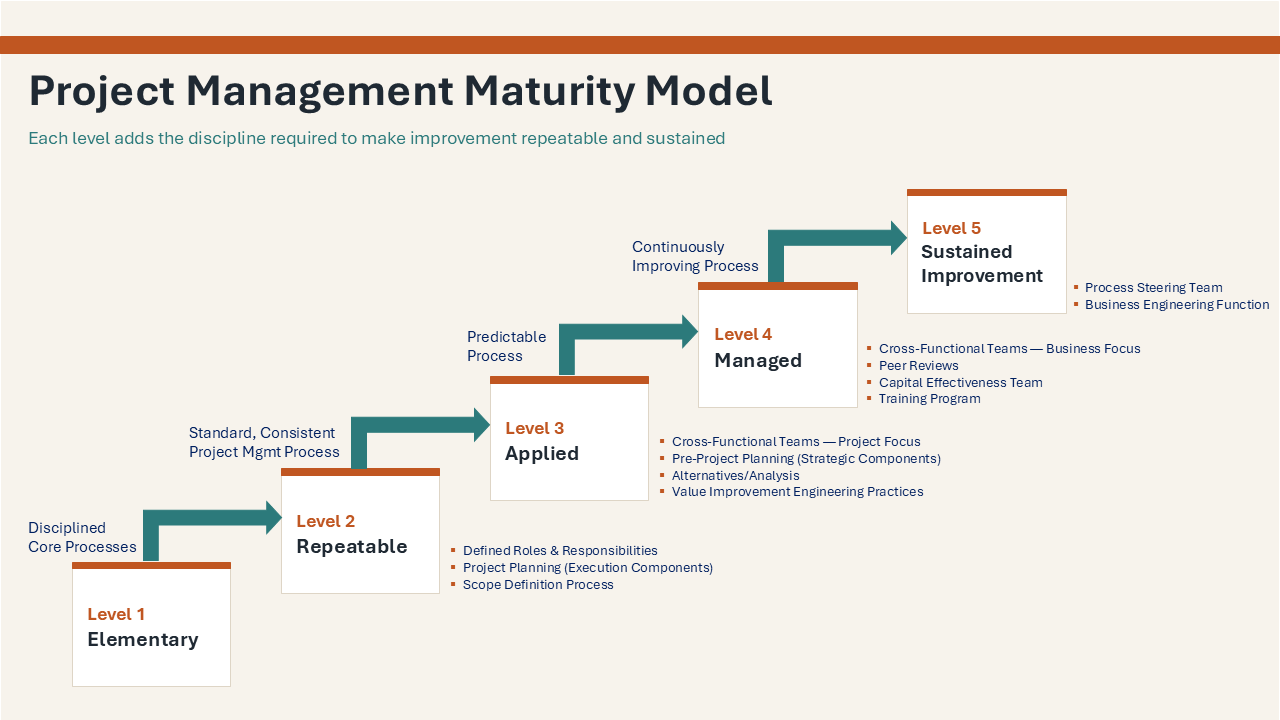
Level 1: Elementary
At the Elementary level, project management activities are largely ad hoc. Processes may exist, but they are inconsistently followed. Project teams frequently react to crises, budgets and schedules are unreliable, and success depends heavily on individual expertise rather than organizational capability.
Level 2: Repeatable
Organizations at the Repeatable level establish basic project management controls. Policies and procedures support project planning, scheduling, and cost management. Teams can reproduce successful practices from previous projects, creating a more disciplined environment for execution.
Level 3: Integrated Application
At this level, project management, engineering, procurement, construction management, and commissioning and start-up activities are standardized and integrated into business operations. A common project delivery process is used across the organization, training programs reinforce best practices, and project teams tailor approved methodologies to fit specific project needs.
Level 4: Managed
Managed organizations rely on quantitative measurement. Project performance, quality, productivity, and process effectiveness are systematically tracked and analyzed. Risks can be identified early, trends can be predicted, and corrective actions can be taken before problems become critical.
Level 5: Sustained Improvement
The highest maturity level focuses on continuous improvement. Organizations proactively identify weaknesses, analyze lessons learned, and adopt innovative practices and technologies. Improvement becomes part of the culture, enabling the organization to continuously expand its capabilities.
Four Dimensions That Matter
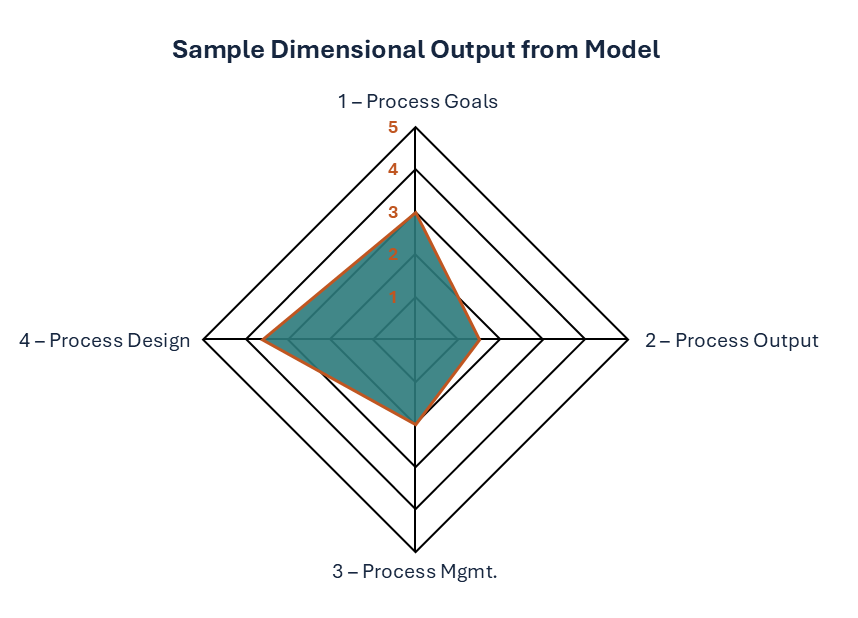
One of the most valuable aspects to recognize is that maturity cannot be measured by a single factor. Instead, organizational capability is evaluated across four interconnected dimensions.
- Process Goals assess whether project activities align with business objectives and stakeholder expectations.
- Process Outputs evaluate the quality, consistency, and effectiveness of project deliverables.
- Process Management examines organizational support, competencies, leadership, accountability, and cross-functional involvement.
- Process Design focuses on methodologies, tools, best practices, and systems that support project execution.
A weakness in any one dimension can limit overall performance. Organizations often invest heavily in process design by creating sophisticated procedures and manuals, yet fail to provide the organizational support or business alignment necessary for successful implementation. In these cases, project performance remains constrained despite substantial investments.
Why Process Improvement Is So Difficult
Many organizations mistakenly assume that introducing a new procedure, training program, or software application will significantly improve performance. Experience shows otherwise.
Project managers, engineers, construction managers, etc. naturally develop habits based on what has worked for them in the past. Over time, those habits become deeply ingrained. Even when better methods exist, professionals may resist changing established practices, particularly if previous improvement initiatives failed to deliver promised benefits.
Compounding the issue, many project management professionals receive limited practical training in planning, risk management, project controls, and team leadership early in their careers. Organizations often expect employees to learn these skills through experience rather than structured development programs.
As a result, sustainable improvement requires far more than publishing new procedures. It demands leadership commitment, training, organizational reinforcement, and a clear demonstration of value to those expected to adopt new processes.
The Danger of Skipping Steps
Organizations often aspire to advanced capabilities such as predictive analytics, sophisticated benchmarking, or enterprise-wide performance metrics. While these capabilities are valuable, Pathfinder's research emphasizes that maturity levels build upon one another.
Attempting to implement advanced measurement systems without first establishing disciplined planning and execution processes often produces frustration. Under pressure, unsupported processes tend to fail precisely when they are needed most.
True organizational excellence is achieved by building a solid foundation and advancing systematically through successive stages of maturity.
Metrics Are Important—But Not Enough
One of the most important messages to grasp is that metrics should support strategy, not replace it.
Organizations frequently become fixated on benchmark comparisons and individual performance indicators. However, project success cannot be reduced to a handful of measurements. Metrics that are disconnected from organizational objectives can create competing priorities and unintended consequences.
The model distinguishes between:
- Leading metrics, which track alignment with business goals and provide early insight into emerging risks.
- Lagging metrics, such as cost and schedule performance, which measure outcomes after events have occurred.
Leading metrics help project teams stay focused on delivering business value, while lagging metrics provide feedback about overall system performance. Successful organizations integrate both types into their management approach.
Final Thoughts
The pursuit of project excellence is not a destination but a journey of organizational development. Ultimately, successful project organizations are not those with the most procedures, the most software, or the most metrics. They are the organizations that align strategy, people, processes, and performance measures around a common objective: delivering business value through successful project execution.